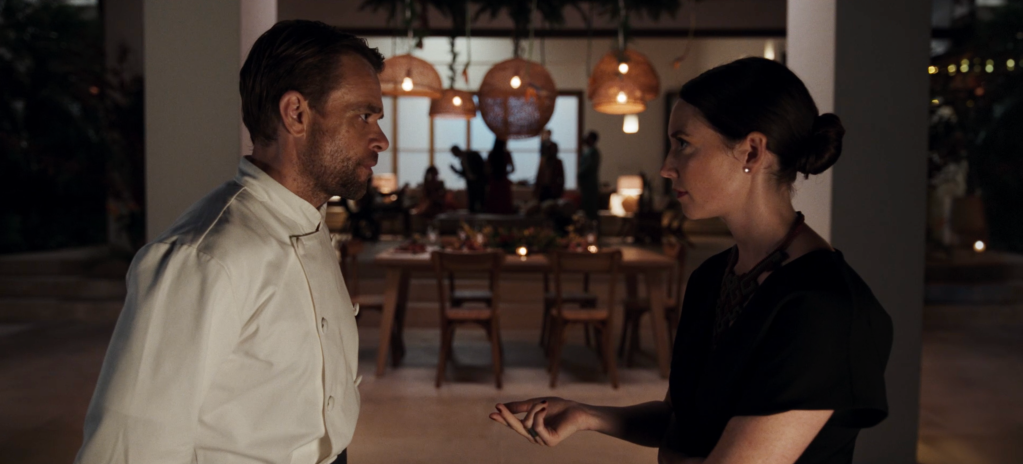
Nicholas Tomnay is the director of What You Wish For, a suspense laden thriller set in the jungles of South America, starring Nick Stahl. Alongside Jeff Russo, Tracie Turnbull co-composed the jittery score, completely over email with Tomnay. The score powers imbues the movie with an uneasy tension that crows through the speakers to the listener themselves. Saint Audio sat down with Tomnay and Turnbull to discuss how the score was created and what the reasons that drove it.
What role did the score have on setting the atmosphere of the movie?
Nicholas Tomnay: So, I put together some temp tracks when I was editing the film, and it was a motley crew of temp stuff, it was kind of all over the place. But I think the one thing that I had was a certain spirit in the temp, and when I gave it to Jeff [Russo], and Tracie [Turnbull], they were like, “This is crazy, what are we going to do here?” So there was a real discussion about there being a spirit in this, and that’s what I was trying to get. Then I kind of handed it over to them for them to begin.
And what did that creative process look like?
NT: I cut the film completely to temp music and had a lot to cut, and then I’d sent them the finished film with the temp music. They began afterwards.
What inspired you to go down the stylistic direction of the score, with a very staccato through line and sparse percussion.
Tracie Turnbull: We were trying to find the sound of the movie, and there was a cue that we had done that we sent over to Nick. He really liked this part of one of the things that we did and it kind of informed us of what we’re going for. It doesn’t want to feel heavy or stodgy or anything like that, it kind of it always kind of propels the movie forward.
Are there any other scores or pieces of music that you can point to that you drew from as inspiration?
TT: I think originally there was some temp music in there that were some classical pieces of music. So I remember talking to Jeff and us being like; “Okay, well there’s this feeling like Carnival of the Animals [by Camille Saint-Saëns], and it had like this kind of mysterious sound, but we need it to match our main character.” So that’s why we wanted a smaller string section. Then, I remember, there was an email with Nick where he suggested using the bassoon, and I think that just tied everything together But no, there wasn’t a score in particular that informed me on this one.
What made you both want to go for a score as opposed to a soundtrack of licensed music for example?
NT: I wanted the whole movie to [feel like we crafted it ourselves]. We limited our focal lengths when we were shooting it, and we limited the colour, and I wanted the music to be completely scored. So in all these things, my hope was that it would create this bubble feeling, that you were in this world. And, having any kind of needle-drops or anything like that, It’s a different type of filmmaking and probably a different experience for an audience. I wanted this to be a completely immersive world, and I thought that the way to do that was to have a score the whole way.
Was the process of creating this score and this film similar or different to others you have worked on in the past?
TT: Like he said, Nick had already temped in the music where he wanted it to be, and that’s very typical for us. It was really nice because Nick was able to give us really specific things that he wanted. That really guided us towards getting this done the way that he envisioned and the way that we were hoping for the music to sound.
There may have been a temptation to cram the score in from all angles but there are plenty of moments in the film where you let the silence speak for itself. How did you manage to avoid just filling the film with the score, and why?
TT: I will give Nick a lot of credit here—when he temped the music, overall, Jeff and I really agreed with [those choices] because there’s moments of silence that make it just super impactful. There’s nothing going on besides the reactions of people, and all of the actors are so good in this that the music would almost take away from the impact.
I love silence in films. I know I shouldn’t say that, but it just makes the music more impactful when you have those moments of silence and choosing where to have the music be.
Are there things that both of you think you will take from this process into future movies?
TT: I think every project that I work on, I learn something new. Whether it’s like: “oh, maybe I could have done something like this a little bit different,” it just happens every time. And I love that, because every single project that I work on is different. Different material, different directors, different showrunners, and what kind of makes this job really fantastic is you never quite know what you’re gonna get. You always want to try to learn from what you’ve done on past projects.
NT: I think for me, and it’s not just with music but with filmmaking generally, it’s a reminder that it’s really important to remain open to unexpected things that come from people that you’re working with. That’s probably one of the greatest parts of filmmaking in a way. You have an idea and you plan, but you’re not doing it yourself, And so someone comes in and they do it their way, and that can completely inspire you and send you on this other direction. All that stuff, that’s the great part about collaborating.
What You Wish For is now available on Digital and On-Demand. For more, follow the film’s official website.
 Saint Audio